Order of draw chart: tube colors, additives and inversions
Fill blood cultures first, then light blue citrate, serum tubes, heparin, EDTA, and gray fluoride/oxalate last; invert each additive tube gently as soon as it comes off the holder.
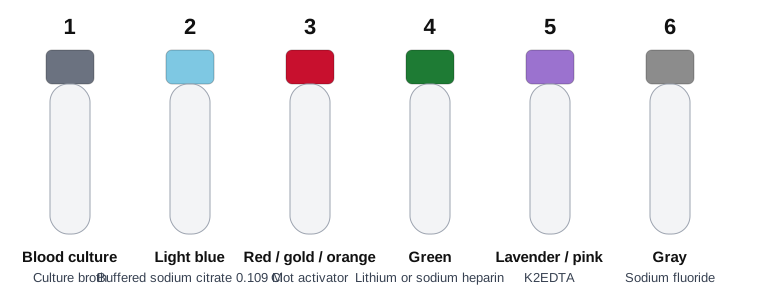
Venous order of draw (CLSI GP41 summary)
| order | tube / closure colour | additive | inversions (BD) | typical tests | why here |
|---|---|---|---|---|---|
| 1 | Blood culture bottles or tube | Culture broth (keeps microbes alive) | Follow the bottle maker | Blood cultures | Collected first so the culture stays sterile and receives no tube additive |
| 2 | Light blue | Buffered sodium citrate 0.109 M (3.2%) | 3-4 | Coagulation: PT/INR, aPTT | Clot activator interferes with clotting tests, so only a culture, a glass non-additive serum tube or a plastic serum tube without clot activator may precede it |
| 3 | Red (plastic: clot activator; glass: no additive); gold or red/gray (clot activator + gel, SST); orange (thrombin-based clot activator + gel) | Clot activator, with or without gel; glass red has none | 5 (plastic red, gold, red/gray); 5-6 (orange); 0 (glass red) | Serum chemistry and serology; orange for stat serum chemistry | Comes after citrate so clot activator never reaches the coagulation tube |
| 4 | Green, light green (heparin + gel) | Lithium or sodium heparin, with or without gel | 8 | Plasma chemistry | Follows the citrate and serum tubes in the CLSI sequence |
| 5 | Lavender (also pink; white with gel) | K2EDTA (plastic) or K3EDTA (glass); white adds gel | 8 | Whole-blood hematology (CBC); pink and K2EDTA for routine blood bank; white for molecular tests such as PCR | EDTA carried into a chemistry tube can falsely raise potassium and lower calcium, so it comes after those tubes |
| 6 | Gray | Sodium fluoride (stops glycolysis) with potassium oxalate or Na2EDTA; or sodium fluoride alone (serum) | 8 | Glucose | Last in the CLSI sequence |
Closure colours follow BD Vacutainer; other manufacturers may differ, so confirm the additive on the label.
The sequence is the same with a tube holder, a syringe or tubes evacuated at collection (CLSI). Fill tubes from a syringe with a blood transfer device (Korean 2025 guideline).
Inversion counts are BD's (BD-83178, June 2024). Other makers, such as Greiner Bio-One, print different counts; follow the count for the tube in your hand.
One inversion = turn the tube 180 degrees and back. Invert gently; never shake.
The full Venous Order of Draw, Additives and Inversions sheet in the app also covers: Other BD tubes: place by additive; Fill, mix and wait.
Sources
- Order of Blood Draw Tubes and Additives (CLSI blog summary of GP41, Collection of Diagnostic Venous Blood Specimens; GP41-Ed7 was replaced by CLSI PRE02-Ed8, 2025) · Clinical and Laboratory Standards Institute
- BD Vacutainer Venous Blood Collection Tube Guide (BD-83178, June 2024; additives, inversion counts, closure colours), manufacturer PDF as distributed to clients by Alverno Laboratories · Becton, Dickinson and Company (copy hosted by Alverno Laboratories)
- Ford RB, Mazzaferro EM. Laboratory Diagnosis and Test Protocols, Table 5-1 Venous Blood Collection Tube Guide (reproduced from the BD Vacutainer Tube Guide). In: Kirk & Bistner's Handbook of Veterinary Procedures and Emergency Treatment, 2012 · Elsevier (via PubMed Central)
- Nikolac N, Supak-Smolcic V, Simundic AM, Celap I. Croatian Society of Medical Biochemistry and Laboratory Medicine: national recommendations for venous blood sampling (based on CLSI H3-A6). Biochem Med 2013;23(3):242-254 (PMC3900082) · Biochemia Medica via PubMed Central
- Magnette A, et al. Pre-analytical issues in the haemostasis laboratory: guidance for the clinical laboratories. Thromb J 2016;14:49 (PMC5154122) · Thrombosis Journal via PubMed Central
- Chang J, et al. Standards and Practice Guidelines for Venous Blood Collection: Consensus Recommendations from the Korean Society for Laboratory Medicine. Ann Lab Med 2025;45(4):343-357 (PMC12187494) · Annals of Laboratory Medicine via PubMed Central
Free Routine Blood Collections practice questions
- Question 1Under CLIA, a laboratory's written labeling procedure must call for the patient's name or a unique identifier and, when appropriate, which other item?
- Question 2Croatian national recommendations allow tubes to be labeled after the draw only if the patient is still seated in front of the phlebotomist. Why?
- Question 3According to MedlinePlus, emergency services should be called when a seizure lasts longer than how long?